


By Michelle Zenarosa and Mariah Castañeda
This article was first published by the nonprofit newsroom L.A. Public Press on June 27, and is republished here with permission.
With federal immigration raids ripping apart immigrant families and communities across Los Angeles, people in LA are doing their best to keep up with news and information about immigration enforcement activities.
But it can be tricky to discern fact from rumor, especially on social media, where stories spread quickly.
We need accurate and reliable information to keep our loved ones safe, and we need it fast. But verified information takes longer to come out of official channels, creating the perfect storm for misinformation to spread.
Misinformation spreads quickly — and goes viral more often than fact-checked news — in part because algorithms prioritize content that makes us feel strong emotions. Those strong emotions keep us glued to social media apps longer. It’s important to slow down when you have a strong emotional reaction to a post.
During emergencies and as news breaks, government alert systems can lack accuracy and timeliness. LA County residents experienced that during wildfires in January and amid recent ICE enforcement activity in the region. This increases the rush to share information online, causing some inaccurate information to potentially spread, like an AI generated video of the Hollywood Sign burning.
In situations where lives and livelihoods are in jeopardy, we need the tools to know who and what we can trust. And in an age where everyone has a phone and can be a citizen journalist, it’s important to handle that responsibility with care. We are here to teach you some critical verification skills.
We are living in an age of disinformation. Most of the general population has not been given the tools to critically assess digital content. While our education system taught us that the “mitochondria is the powerhouse of [the] cell,” it neglected to show us how to discern fact from fiction in a rapidly changing media world.
The good news is it’s possible to be a better media consumer, and we can’t wait for you to try these skills the next time you’re using social media.
Examples of misinformation we’ve seen:

Fire-related false claim: During the 2025 LA Fires a fake image circulated around social media of the Hollywood Sign engulfed in flames. Reuters and other newsrooms were quick to dispel the image’s authenticity and suggested that the image might have been AI generated or created with editing software.
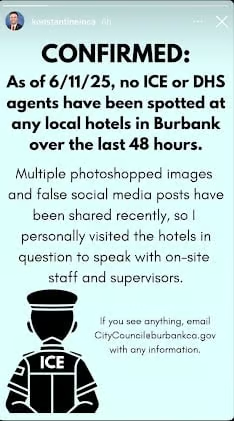
Immigration enforcement misinformation: False claims about ICE raids at Burbank hotels spread on social media, prompting this correction from a city council member who personally visited the locations to verify no enforcement activity was occurring.
Now that you’ve seen how misinformation looks and spreads, let’s learn how to catch it before you share it. Here’s how to verify what you’re seeing on social media.
LA Public Press spoke with digital literacy expert Michael Caulfield for this guide and loosely based these steps on Caulfeild’s SIFT method, which helps users quickly evaluate online information by focusing on four key verification techniques.
Step 1: Slow down!
If you find content with information that you’re interested in, pause. Ask yourself: How is this information making me feel? As digital literacy expert Michael Caulfield wrote in his open educational resource (OER) textbook “Web Literacy for Student Fact-Checkers,” “When you feel strong emotion–happiness, anger, pride, vindication–and that emotion pushes you to share a ‘fact’ with others, STOP. Above all, these are the claims that you must fact-check.”
In an interview with LA Public Press, Caulfield said the most common feeling where we go wrong as content consumers is the feeling that a post proves, “I was right all along.”
“You’re going to look for things that validate what you were already thinking,” said Caulfield.
Red Flags: Warning signs of potential misinformation
- Urgent language like “BREAKING,” “MUST SHARE NOW,” or “Before it gets deleted”
- Claims that “they don’t want you to know this” or “the media won’t tell you”
- Missing dates, locations, or source attribution
- Emotional language designed to make you angry or afraid
- Poor grammar, spelling, or formatting in “news” posts
- Screenshots of text without links to original sources
- “A friend of a friend said…” or vague sourcing
Example: This message shows vague sourcing (“my mom group”), fear-based claims, and no links to official sources or verification—classic signs of unverified information that spreads during crisis situations.

These particular rumors about ICE detaining nannies at Santa Monica and LA area parks were later dispelled by Santa Monica Mayor Lana Negrete and police, who confirmed no such enforcement actions had occurred and no children had been separated from caregivers.
Step 2: What accounts are making this claim? (i.e., investigate the source)
Does the person or organization running the account have firsthand experience? Are they a primary source? If not, does the account belong to a credible journalist, scientist, academic, organization or newsroom? If so, double-check that the individual account indeed belongs to the institution they say they work for.
Exercise extra caution when you see rumors being presented as facts.
Step 3: What claims is this post making? Find better coverage
Where else can I find this information? What’s the primary source? Try searching the claim online and see if any credible sources can verify this claim. If there’s an image that accompanies the claim, try reverse-searching the image on Google to investigate the photo’s validity.
Verification tools:
- Image verification: Google Reverse Image Search, TinEye
- Fact-checking sites: Snopes, FactCheck.org, PolitiFact, Fact Check from Duke Reporters’ Lab, SciCheck, NPR Fact Check
- Local LA resources: City of LA official Twitter, LA County alerts
- Emergency info: Ready.gov, LA County emergency alerts
- Your local newsrooms: LA Public Press, LA Taco, Caló News, Capital and Main, LAist,and more!
A note about AI:
With AI generated content increasingly flooding our news feeds, some might wonder how to distinguish real images from AI ones. Caulfield says that when evaluating images that could be AI, social media users should apply the same rules as evaluating any other image.
“The best way to figure out… how you should evaluate a picture or a photo or any piece of data is to figure out who took it, where they took it, what their purpose was in taking it [and] when they took it,” Caulfield said.
Caulfield also said that oftentimes, misinformation doesn’t even need AI to spread; unsubstantiated claims spread on the internet without any help from AI.
Step 4: Where is the information coming from? Trace claims, quotes and media to the original context
Many times, influencers on Instagram and TikTok present news in a digestible way, even though they themselves are not breaking the news themselves. That’s fine, but check to see if they cite their sources (i.e., news articles, academic studies and reports, government press releases). Then look up the sources they cite. If there are no sources cited, proceed with caution and search for claims that are made.
Step 5: Why is this content being shared?
To inform? To sell something? To garner reactions? Social media platforms want you to stay on their apps for as long as possible, so polarizing content tends to do well and is rewarded. Knowing why something was shared can help you evaluate the validity of a claim and decide how much scrutiny to apply to a claim.
Learn more about the SIFT method here.
What to do if you’ve shared misinformation:
- Delete the original post as soon as you realize the error
- Post a correction explaining what was wrong and linking to accurate information
- Don’t just quietly delete — your followers deserve to know about the correction
- Learn from it — use it as a teaching moment about verification
Example correction post: “I’ve shared incorrect information about [topic] earlier. Here’s what actually happened: [accurate info]. I should have verified before sharing. Thanks to those who pointed this out!”
Here’s a real example of how to post a correction:
Documenting immigration enforcement: A special note
If you witness immigration enforcement activity, documentation can be important for community safety. The California Collaborative for Immigrant Justice recommends these steps:
- Identify safely: If it’s safe to do so, ask agents to identify themselves and their agency. Officers should wear identifying vests, though advocates note they sometimes wear police vests or unmarked clothing.
- Document thoroughly: Take photos and videos when safe, noting the date, time, and location of any activity.
- Verify before sharing: Remember the principle “no proof, no post.” Share verified information, not fear.
LA Public Press is an independent newsroom that publishes news in support of a healthier Los Angeles. The non-profit does journalism that interrogates systems of power while supporting those trying to build more equitable and resilient communities.